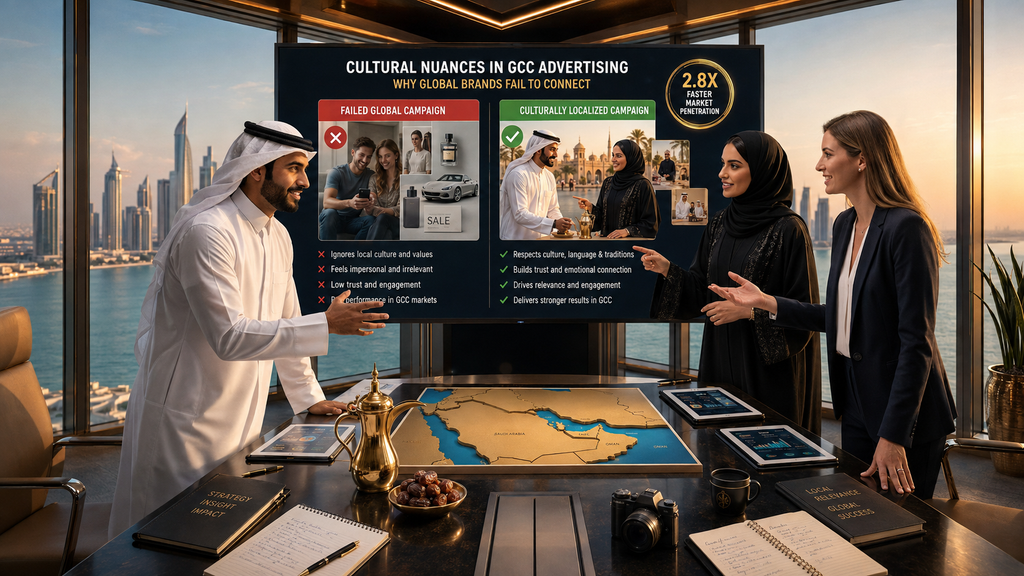
| 2.8x Faster market penetration for brands demonstrating authentic GCC cultural respect (Cultural PR Best Practices Study, 2025) |
Why do global brands spend millions on advertising in the GCC and still fail? It is not because of weak creativity, nor because of insufficient budget. Instead, the real reason is that they do not understand the culture.
We have seen this repeatedly. For example, global campaigns that performed excellently in Europe or the US can land completely flat in Doha. Again, this is not because the execution was poor, but rather because the message was built for a different cultural context. As a result, Gulf audiences can detect that disconnect almost instantly.
In the GCC, what you say certainly matters. However, how you say it, who says it, what they are wearing, and whether the message feels genuinely local often matter even more. Therefore, when brands get these details wrong, they do not simply lose attention they lose trust. And in Qatar’s tightly networked business community, that matters because lost trust travels fast.
| Brands that invest in cultural intelligence achieve 2.8x faster market penetration and 78% stronger brand trust versus brands that treat GCC as a straightforward market extension. (Source: Cultural PR Best Practices Guide, MEPRA 2025) |
The Hidden Risk Most Global Brands Underestimate in the GCC
The GCC is frequently treated as a single homogeneous market. It is not. Saudi Arabia, Qatar, the UAE, Kuwait, Bahrain, and Oman have distinct cultures, regulatory environments, media landscapes, and audience expectations. What resonates in Dubai can fail completely in Doha.
Brands making this mistake operate at a structural disadvantage they are using a GCC playbook that does not exist. The market demands hyper-localization: not just translating messages, but rebuilding them from the cultural context up.
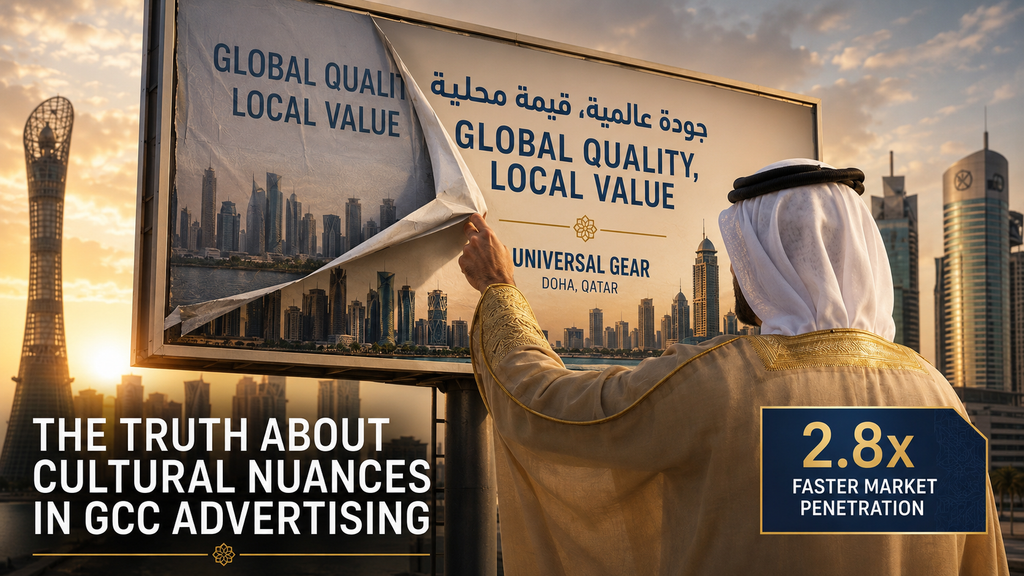
Why Translation Is Not Localization in the GCC
Most global brands assume that translating marketing materials into Arabic completes the localization requirement. However, research consistently shows that this assumption is wrong.
Arabic in the GCC is layered. For instance, there is Modern Standard Arabic, which is commonly used in formal written communication, Gulf Arabic, which is widely spoken in Qatar and across the Gulf, and Lebanese Arabic, which is often used in professional media production. Therefore, using the wrong register can immediately signal to native speakers that the brand is not genuinely local instead, it may feel like the brand is simply performing localization.
Moreover, the visual layer is equally important. Images of Western settings, non-local faces, or clothing that does not reflect local norms can create an immediate cultural distance. As a result, even the strongest headline may not be enough to overcome that disconnect.
The GCC Cultural Advertising System That Actually Works
Most global brands use this failing approach:
| ❌ Global Campaign → Arabic Translation → Launch |
Winning brands in the GCC use this system:
| ✅ Cultural Research → Audience Segmentation → Locally Rebuilt Message → Culturally Verified Creative → Trust → Conversion |
8 Cultural Principles That Govern Advertising Effectiveness in the GCC
1. Family Values Are the Primary Buying Motivation
In GCC markets, purchasing decisions are often made in the context of family wellbeing rather than individual preference. As a result, campaigns that feature togetherness, shared experiences, and respect for multi-generational family values consistently outperform individualism-focused messaging. Importantly, this principle applies across many industries, from automotive advertising and financial services to food brands.
2. Gender Representation Requires Cultural Calibration
Strong GCC advertising represents women authentically in roles that reflect actual Qatari and Gulf society, with appropriate visual representation. However, campaigns that import Western visual norms regarding gender without local calibration can face significant backlash. In contrast, campaigns that genuinely reflect the aspirations and values of local women can build lasting brand loyalty.
3. Religion Shapes the Calendar And the Content
Religion influences daily behavior, seasonal consumption, and communication style throughout the year and most intensely during Ramadan. Therefore, brands that adapt their messaging, tone, and campaign timing for Ramadan focusing on community, generosity, and spiritual resonance rather than transactional urgency consistently outperform those that do not. On the other hand, brands that ignore Ramadan risk losing relevance during one of the most commercially significant seasons of the Gulf year.
4. Luxury in the GCC Means Something Different
Luxury in the GCC is not purely about status signaling. Instead, it combines identity, heritage, hospitality, and community standing. For this reason, luxury brands that feel warm, human, and culturally embedded rather than aloof and globally generic achieve stronger purchase intent in this market.
5. Local Faces and Environments Are Non-Negotiable
Research across GCC markets shows that the visual representation of local faces, familiar architectural environments, and culturally recognizable settings dramatically increases advertising effectiveness. Consequently, content that looks imported is less likely to convert in a market where authenticity is a primary trust signal.
6. Humor Requires Cultural Expertise to Deploy
Humor is powerful in advertising however, it is also one of the highest-risk creative choices in cross-cultural marketing. What is funny in one cultural context may be incomprehensible, offensive, or tone-deaf in another. Therefore, in the GCC, the safest humor tends to be relatable, human, and self-aware rather than edgy, sarcastic, or politically sensitive.
7. The Expat Audience Requires Its Own Strategy
Qatar’s population is approximately 88% expatriate. As a result, Arab expats, South Asian professionals, and Western executives may respond to different cultural cues, visual languages, and emotional triggers. Therefore, a single creative execution cannot always speak authentically to all three groups. Instead, brands should segment both their audience and their creative accordingly.
8. Trust Is Built Before the Sale, Not During It
In GCC business culture particularly in B2B contexts relationships are often established before commercial transactions begin. Because of this, advertising that positions a brand as a trusted authority, community member, or long-term partner consistently outperforms advertising that leads with a transactional offer. Ultimately, this is not simply a different approach to GCC advertising it is the foundation.
Frequently Asked Questions GCC Cultural Advertising
Q: Do I need to create separate campaigns for different GCC countries?
A: Yes at minimum, Qatar and Saudi Arabia require distinct creative approaches despite shared language. Doha is cosmopolitan and internationally oriented. The Saudi market is younger, more nationalistic, and currently undergoing rapid cultural change. The UAE sits between these two. Generic pan-GCC campaigns almost always underperform market-specific executions.
Q: How should brands approach Ramadan advertising in Qatar?
A: Lead with community, generosity, and values not promotions. The emotional register shifts significantly during Ramadan. Brands that produce dedicated Ramadan creative adapted messaging, color palettes, and storytelling build year-round loyalty through a single seasonal campaign.
Q: What is the biggest cultural advertising mistake in Qatar?
A: Treating ‘translation’ as ‘localization.’ Translated copy in culturally foreign imagery with a generic global visual language does not register as local and Qatari audiences are sophisticated enough to recognize the difference immediately.
| Is your GCC advertising culturally calibrated for this market? We audit your messaging, creatives, and positioning — free, no pitch. → Book Your Free GCC Strategy Audit → www.the8thmiracle.com |
Related: Digital Marketing Qatar | Social Media Strategy Qatar | Influencer Marketing Doha | QFC Company Digital Guide