Influencer marketing in Dubai and Doha is everywhere. But behind the visible reach and curated content, a harder question is emerging: are you buying influence or renting attention that disappears the moment the post leaves your audience’s feed?
The global influencer marketing industry reached $32.6 billion in 2026 growing 19x since 2016 (Socially In, April 2026). The GCC creator economy specifically grew 75% in the two years to 2025, reaching nearly 263,000 influencers across the Gulf (Communicate Online, 2026). The scale is undeniable. But scale has never been the issue.
The question is: is your influencer strategy built around reach or around revenue?
| Brands earn an average $5.78 for every $1 spent on influencer marketing. Top-performing GCC campaigns particularly those using local micro-influencers with strong niche audiences have achieved $11–18 ROI per dollar invested. (Influencer Marketing Hub, Archive, 2026) |
Why Influencer Marketing Still Works But Not the Way It Used To
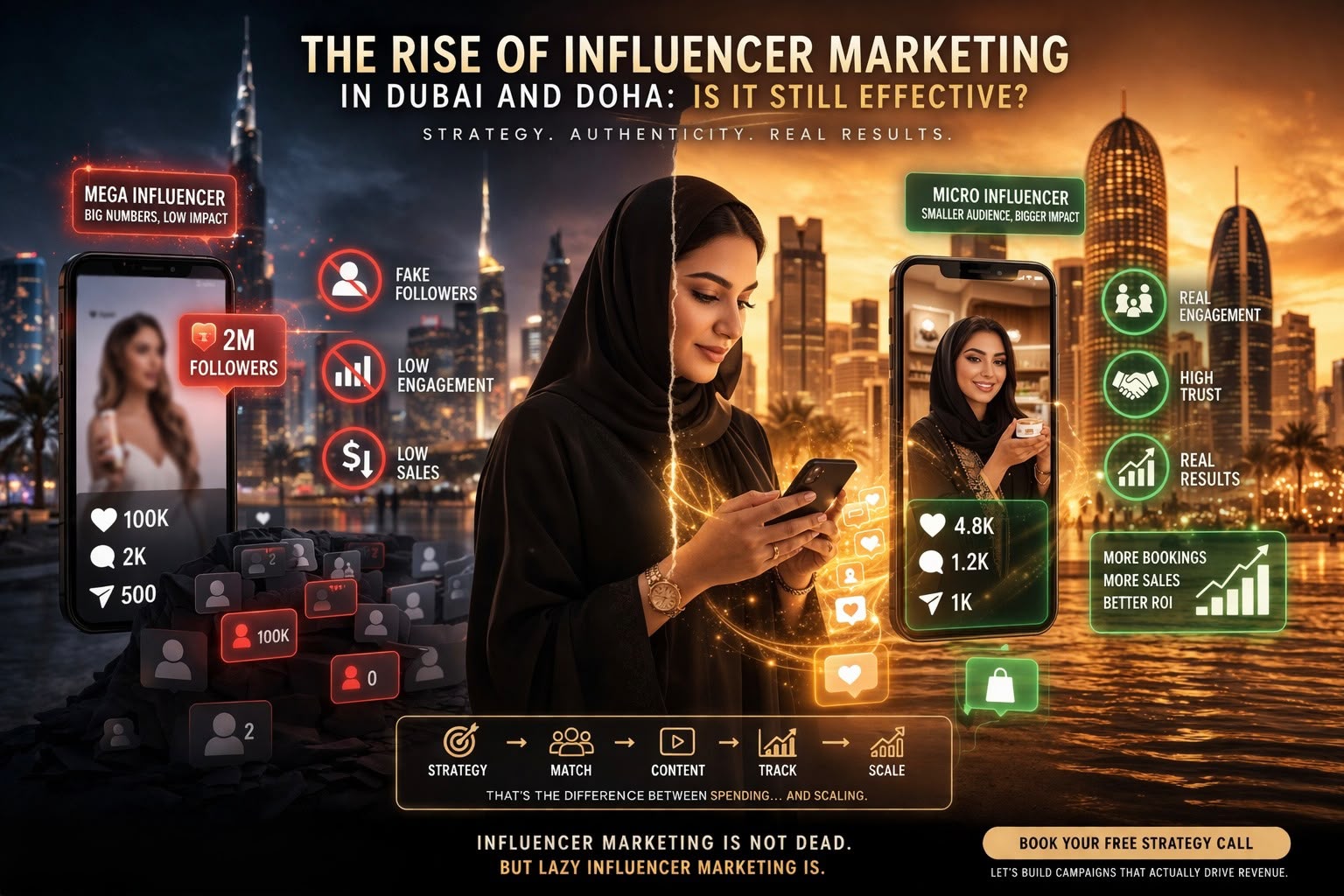
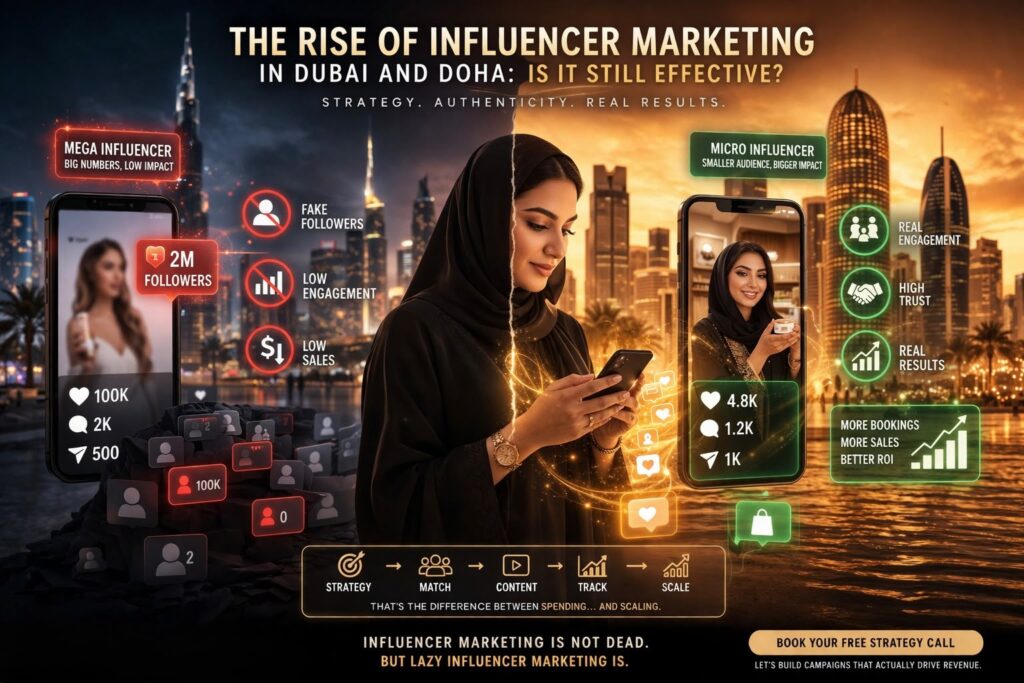
Influencer marketing is not dead. Lazy influencer marketing is. In fact, consumers in 2026 especially in sophisticated, high-trust markets like Qatar and the UAE can instantly detect content that feels transactional, forced, or misaligned with the creator’s genuine voice.
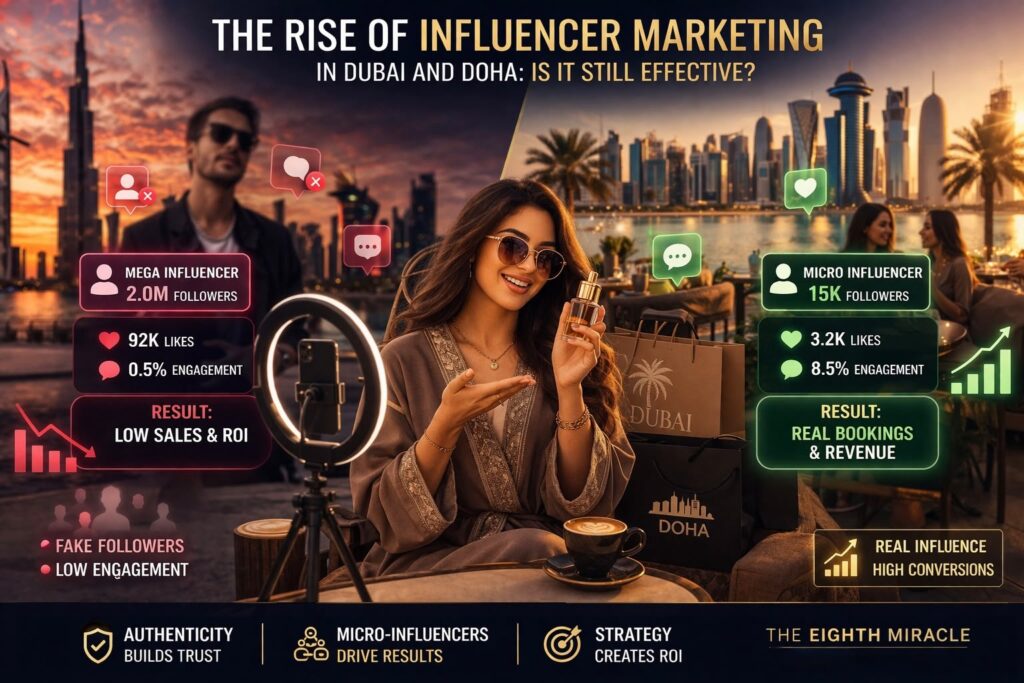
Meanwhile, the mega-influencer era is structurally weakening. For example, an account with 2 million followers and low authentic engagement consistently delivers weaker conversion rates than a micro-influencer with 15,000 deeply engaged, locally relevant followers. Importantly, this is not a trend. Rather, it is now supported by data across thousands of GCC campaigns.
The Data: Micro-Influencers vs Mega-Influencers in 2026
| Metric | Nano (1K–10K) | Micro (10K–100K) | Mega (1M+) |
| TikTok Engagement Rate | 10.3% | 3.86% | ~0.9% |
| Instagram Engagement | 1.73% | 2.1% | 1.21% |
| Cost per Post | $10–$100 | $100–$1,000 | $10,000+ |
| Audience Trust Level | Very High | High | Lower |
| Conversion Rate Advantage | Highest | High | Lowest |
The Influencer Marketing System That Actually Generates Revenue in Qatar
Most brands still operate on the legacy model:
| Pay Influencer → Post → Hope for Sales |
The brands generating consistent revenue from creator partnerships in the GCC use this system:
| Vet Influencer (authentic audience, local relevance, low fake followers) → Brief with conversion CTA → Track link clicks, DMs, and promo codes → Retarget warm audience with paid ads → Measure CAC and ROI per creator |
How to Choose the Right Influencers for Your Qatar Campaign
Step 1: Audit for Fake Followers Before Spending Anything
A Localogy audit of 8 million influencer accounts, for instance, found significant levels of inflated follower counts across social platforms. Fortunately, tools like HypeAuditor, Modash, and IQFluence allow you to verify authentic engagement rates, audience geography, and follower quality before committing budget. Specifically for a Qatar campaign, verify that at least 30–40% of an influencer’s audience is actually based in Qatar or the wider GCC
Step 2: Prioritise Relevance Over Reach
The highest-converting influencers for Qatar brands in sectors like real estate, hospitality, beauty, and F&B are not necessarily those with the largest followings. They are those with the most relevant audience professionals, decision-makers, and consumers who match your dream client avatar exactly.
Step 3: Brief for Conversion, Not Just Awareness
Most influencer briefs only specify what to say. High-converting briefs specify what action the audience should take: ‘DM the creator for a free consultation’, ‘use code [EIGHTH] for 10% off’, or ‘tap the link in bio to book directly.’ Every influencer post should have one clear next step connected to a trackable system.
Step 4: Track the Right Metrics
Most brands track reach and impressions. The metrics that matter for revenue are: cost per acquisition (CPA), click-through rate, WhatsApp DM volume after post, promo code redemptions, and for brand campaigns brand search volume uplift in the week following the post.
Step 5: Retarget the Warm Audience
Anyone who engaged with the influencer’s post viewed a Story, liked a Reel, clicked a link is a warm prospect. Running a retargeting campaign on Meta to this engaged audience within 24 – 48 hours of the influencer post consistently doubles the ROI of creator campaigns in the GCC.
Frequently Asked Questions Influencer Marketing Qatar
Q: Is influencer marketing effective for B2B businesses in Qatar?
A: Yes particularly on LinkedIn, where creator content from thought leaders in relevant industries consistently drives decision-maker engagement. For B2B, micro-influencers with strong professional networks in specific sectors (real estate, finance, healthcare) outperform general lifestyle creators significantly.
Q: How do I find legitimate micro-influencers in Doha?
A: Search location-tagged posts on Instagram using #Doha, #Qatar, and industry-specific hashtags. Filter by engagement rate (above 3% for accounts under 100K is strong). Use tools like Hype Auditor or Modash to verify audience authenticity before approaching.
Q: What ROI should I expect from influencer marketing in Qatar?
Industry data shows an average $5.78 return per $1 spent globally. Well-optimized GCC campaigns with local micro-influencers and proper retargeting have achieved $11–18 ROI per dollar. Campaigns without a conversion system consistently underperform regardless of influencer quality.
| Are your influencer campaigns generating real ROI? We analyze your influencers, tracking system, and conversion strategy free, no pitch. → Book Your Free Influencer Audit → www.the8thmiracle.com |
Related: Digital Marketing Qatar | Social Media Strategy Qatar | GCC Cultural Advertising | QFC Company Digital Guide